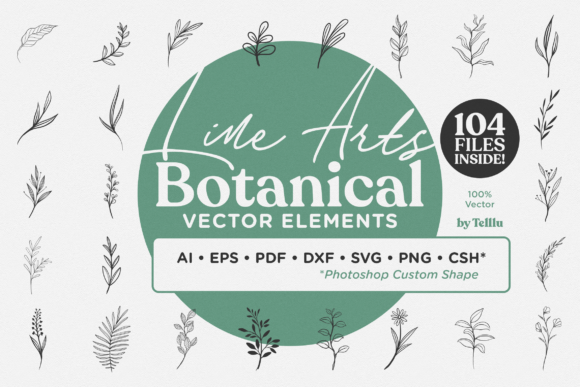
Line Art Botanical Vector Elements for Creative Professionals
In the evolving landscape of digital design, few resources offer the same blend of timeless elegance and practical versatility as Line Art Botanical Vector Elements. These handcrafted line art botanical floral graphic elements in vector formats have quietly become a staple for designers, stationery creators, brand specialists, and content producers who value both aesthetic refinement and technical flexibility. This article explores what these elements are, why they matter, how they work across different media, and who stands to benefit most from integrating them into a creative workflow.
Understanding Line Art Botanical Vector Elements
At its core, a line art botanical vector element is a digitally rendered illustration of a plant, flower, leaf, or botanical motif created using clean, continuous lines rather than filled shapes or gradients. The "vector" aspect means the graphic is defined by mathematical paths, not pixels, so it remains crisp and sharp at any scale. The "handcrafted" descriptor indicates the line work retains the organic feel of hand-drawn illustration, even though the final file is digital.
These elements are distinct from raster images (like photographs or scanned drawings) because they can be resized from a postage stamp to a billboard without any loss of quality. The color is also fully changeable, allowing designers to match brand palettes or seasonal themes with a few clicks. This combination of hand-drawn character and technical precision makes them uniquely suited for projects where texture and polish are equally important.
What Makes These Vector Elements Valuable?
The value of Line Art Botanical Vector Elements lies in several intersecting qualities that address common pain points for creative professionals.
- Scalability without compromise – Because they are vector-based, these elements can be enlarged or reduced infinitely. A delicate vine used on a business card can become the central motif of a large-format poster without pixelation or blurring.
- Color flexibility – Every element's color can be edited in software like Adobe Illustrator, Photoshop, or Affinity Designer. This means a single leaf can shift from deep forest green to blush pink to metallic gold depending on the project.
- Handcrafted aesthetic – Unlike generic clip art, these line art botanicals carry the nuance of hand drawing. Slight variations in line weight, organic curves, and natural asymmetry give them a warmth that feels intentional rather than mechanical.
- Cross-platform usability – The included formats (AI, EPS, PDF, DXF, SVG, PNG, and CSH) ensure compatibility with virtually any design software, from professional suites to web-based tools and even CAD programs for laser cutting.
- Bulk quantity with variety – With 104 files in total, users receive a substantial library of motifs rather than a handful of generic shapes. This allows for rich compositions and repeated use across different projects.
Where Can You Use Line Art Botanical Vector Elements?
The practical applications for these graphics are remarkably broad. Below are some of the most common scenarios where they add tangible value.
Wedding Stationery and Event Materials
Wedding invitations, save-the-dates, place cards, menus, and thank-you notes often rely on botanical motifs to convey romance, growth, and natural beauty. Line Art Botanical Vector Elements allow stationery designers to create cohesive suites where the same floral line work appears on the invitation, the envelope liner, the ceremony program, and even the table signage. Because the elements are vector, they can be scaled to fit a small stamp or a large welcome sign while maintaining visual consistency.
Branding and Identity Projects
For businesses in the wellness, beauty, wedding, lifestyle, or hospitality sectors, botanical line art offers a clean yet organic brand language. A spa logo might use a single leaf motif; a skincare line could incorporate multiple flower forms across packaging, labels, and website icons. The changeable color means the same element can appear on a white background, a dark bottle, or a textured cardstock without looking out of place.
Social Media and Blog Content
Content creators and social media managers frequently need decorative elements that are visually appealing but not distracting. Line art botanical floral graphic elements work beautifully as dividers between blog sections, accent graphics for Instagram Stories, subtle backgrounds for quote posts, or framing devices for product photography. Their light, airy line weight suits minimalist and modern aesthetics.
Patterns and Fabric Design
Because the elements are scalable and editable, designers can arrange them into repeating patterns for textiles, wallpapers, wrapping paper, or digital backgrounds. The handcrafted line quality prevents the pattern from feeling repetitive or artificial, giving fabric and paper goods a bespoke appearance.
Packaging and Labels
Product packaging for candles, soaps, teas, cosmetics, and gourmet foods often benefits from botanical imagery. Vector elements integrate seamlessly into packaging dielines, and the ability to change color means a single motif can be adapted for different product lines or seasonal releases.
Digital and Print Media of All Kinds
From e-book illustrations and website hero graphics to brochures, flyers, and signage, these elements serve as versatile building blocks. They can be used as standalone art, combined to create larger compositions, or incorporated into existing layouts as embellishments.
Who Benefits from Using These Elements?
While the applications are broad, certain groups find Line Art Botanical Vector Elements particularly useful.
- Freelance graphic designers who need a reliable library of motifs for client work across multiple industries.
- Wedding and event planners who design or commission stationery and want a consistent visual theme.
- Small business owners handling their own branding, packaging, or social media content without a dedicated design team.
- Print-on-demand sellers creating products like mugs, t-shirts, phone cases, and wall art with floral themes.
- Hobbyists and DIY creators who enjoy customizing invitations, gifts, or home decor with professional-quality graphics.
- Educators and workshop facilitators who teach design or crafts and need exemplary vector resources to share with students.
File Formats and Technical Considerations
Understanding the included file formats helps users choose the right one for their workflow. The collection includes 104 files total:
- 1 AI File – Native Adobe Illustrator file, editable with full layer structure and paths.
- 26 EPS Files – Encapsulated PostScript files, widely compatible with older and newer vector software.
- 1 PDF File – Universal format for preview, printing, and import into many applications.
- 25 DXF Files – Drawing Exchange Format, ideal for laser cutting, embroidery, and CAD software.
- 25 PNG Files – Raster previews with transparent backgrounds, useful for quick placement or web use.
- 25 SVG Files – Scalable Vector Graphics, perfect for web development, app design, and responsive interfaces.
- 1 CSH File – Custom Shape file for Adobe Photoshop, enabling direct access as preset shapes.
Installing the CSH File in Adobe Photoshop
The CSH format is particularly convenient for Photoshop users who want quick access to these line art botanical floral graphic elements as custom shapes. The process is straightforward:
- Simply select the CSH file and open it with Adobe Photoshop.
- The vectors will automatically copy into your presets manager.
- To access them, go to Edit > Presets > Presets Manager.
- Set the Presets Type to Custom Shapes.
- Your installed botanical shapes will appear and be ready to use with the Custom Shape Tool.
This eliminates the need to open separate files for every use and keeps the elements organized within the software's native interface.
Strengths and Practical Limitations
No creative resource is without its considerations. Understanding both strengths and limitations ensures you choose the right tools for your needs.
Strengths
- Exceptional versatility across print, web, packaging, and fabric applications.
- Handcrafted line quality that distinguishes work from generic, automated vector art.
- Full color editability and infinite scaling preserve professional quality.
- Multiple file formats reduce compatibility headaches with clients or collaborators.
- Large library size (104 files) offers depth and variety, reducing the need to source additional assets.
Limitations and Considerations
- Because the elements are line art, they are unsuitable for projects requiring filled color illustrations or photorealistic floral imagery. They excel as decorative motifs, not as standalone detailed artwork.
- Users unfamiliar with vector software may need a brief learning curve to edit colors or combine elements effectively.
- The handcrafted aesthetic may not suit ultra-modern, geometric, or rigidly symmetrical design styles.
- While the CSH installation is simple, users of other software like CorelDRAW or Affinity will work primarily with AI, EPS, or SVG formats.
How to Evaluate Whether These Elements Fit Your Project
Before investing in any design asset, it helps to ask a few targeted questions.
- What is the visual tone of the project? If you are aiming for clean, organic, minimalist, or romantic, these line art botanicals align well. If the project demands bold, filled color fields or heavy textures, look elsewhere.
- How much customization do you need? If you require motifs that can change color and size dynamically, vectors are ideal. If you simply need static floral images for quick use, the included PNGs may suffice, but the full value lies in editability.
- What software do you and your collaborators use? The range of formats ensures nearly any workflow is supported, but checking compatibility ahead of time is always wise.
- How many unique motifs do you need? With 104 files, this collection is better suited for ongoing or multi-asset projects than for a single one-off design.
- Is the handcrafted look important? If your brand or client values the human touch, the hand-drawn quality of these elements is a distinct advantage over sterile computer-generated lines.
Real-World Scenarios and Applications
To illustrate the practical value, consider a few scenarios.
Scenario A: The Wedding Invitation Suite
A stationery designer receives a request for a spring-themed wedding suite with wildflower motifs. Using Line Art Botanical Vector Elements, they select several flower stems and leaves, adjust the line color to a soft sage green, and scale them to fit the invitation, reply card, and envelope liner. The same elements are reused on the website and on a large welcome sign for the venue. The consistent line art creates a cohesive visual story from paper to digital to signage.
Scenario B: Skincare Brand Launch
A small business owner is launching a line of organic facial oils. They need labels, a website, social media graphics, and a brochure. Using the vector elements, they select a single leaf motif for the logo, several florals for label patterns, and a medley of stems for blog post dividers. The ability to change colors from cream to deep green ensures the graphics work on both light and dark packaging. The scalable vectors also allow the same leaf to be used as a tiny watermark and as a large wall decal for a trade show booth.
Scenario C: Laser-Cut Home Decor
A craftsperson creating laser-cut wooden wall art needs DXF files compatible with their cutting machine. The included DXF format allows them to import line art botanical floral graphic elements directly into their software, resize them precisely, and produce intricate wooden panels, lanterns, and ornaments with clean, detailed cuts.
Final Thoughts on Choosing Line Art Botanical Vector Elements
Line Art Botanical Vector Elements represent a thoughtful intersection of artistry and utility. They are not a one-size-fits-all solution, but for the many projects where organic elegance, scalability, and color flexibility are paramount, they offer exceptional value. Whether you are a seasoned professional or a creator handling design tasks on the side, the combination of handcrafted line work, comprehensive file formats, and ease of installation (especially the CSH custom shapes for Photoshop) makes this collection a practical addition to your toolkit.
The key to getting the most out of these elements is to treat them as building blocks rather than finished art. Mix, scale, color, and combine them to create compositions that feel unique to each project. When used with intention, they elevate the visual language of stationery, branding, packaging, and digital content without overwhelming the overall design. For anyone seeking a reliable, beautiful, and flexible set of botanical motifs, this collection deserves a close look.
Explore the possibilities. Let the line art speak for itself.