New Zealand Fantail Bird: The Pīwakawaka and Its Timeless Retro Woodcut Illustration
There is something instantly captivating about the New Zealand Fantail Bird. Known in Māori as pīwakawaka, and scientifically as Rhipidura fuliginosa, this small insectivorous bird has long been a beloved icon of Aotearoa's forests and gardens. Its most distinctive feature is, of course, its fanned tail, which opens and closes like a delicate fan as it flits through the undergrowth. This behaviour is not merely charming — it is a highly effective hunting strategy. By constantly moving and fanning its tail, the fantail startles insects into flight, making them easier to catch. Observing one in action is to watch a master of agility and precision.
Beyond its ecological role, the New Zealand Fantail Bird holds a deep place in Māori mythology. It is often seen as a messenger, a bringer of news, and a symbol of the presence of the spiritual world. Some traditions regard the fantail as a harbinger of both good fortune and change. Its fearless curiosity around humans has made it one of the most recognisable and endearing native birds in New Zealand. Whether you spot one during a bush walk or in a suburban backyard, the fantail rarely goes unnoticed.
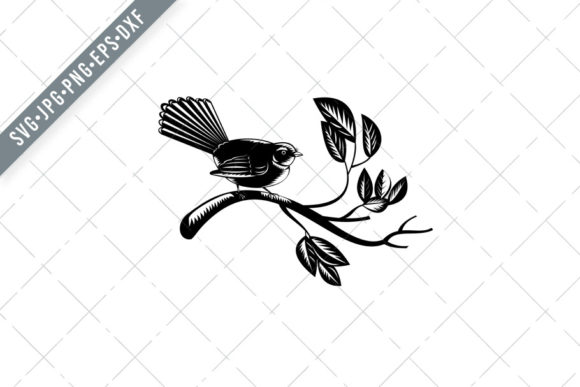
Now, imagine this same energetic bird captured in a completely different medium — a retro woodcut style illustration. The contrast is striking. Where the living bird is all motion and soft grey-brown feathers, the woodcut version is bold, graphic, and unapologetically black and white. It strips the image down to its essence: the sharp angles of the tail feathers, the delicate curve of the branch, and the alert posture of the bird itself. This is not a photograph trying to mimic reality. This is art that celebrates line, texture, and negative space.
Why a Retro Woodcut Style Works So Well for the Fantail
The retro woodcut style draws from a long tradition of relief printing. Historically, woodcuts were used to illustrate books, posters, and botanical studies. The technique requires carving away the background of a wooden block, leaving the image raised to accept ink. The result is bold, high-contrast imagery with a distinct handcrafted feel. When applied to the New Zealand Fantail Bird, this aesthetic does more than just depict the bird — it amplifies its visual impact.
The fantail's tail, with its radiating feathers, is a natural subject for the woodcut approach. Each feather can be rendered as a clean, sharp line, creating a sense of rhythm and repetition. The fanned tail becomes a radial pattern that draws the eye. The isolated background in black and white ensures that nothing competes with the bird's form. This purity of design is exactly why retro woodcut illustrations remain so popular in modern design projects. They offer clarity, boldness, and a tactile quality that digital-first graphics sometimes lack.
Additionally, the monochrome palette makes the illustration incredibly versatile. Whether you are working on a vintage-inspired poster, a minimalist home decor piece, or a branded product, black and white artwork integrates seamlessly into nearly any colour scheme. You can leave it as is for a classic look, or invert it for a dramatic effect. The retro woodcut style gives the fantail a timeless quality — it could have been printed a hundred years ago, or designed this morning.
The Design Elements That Make This Illustration Stand Out
What exactly goes into a successful woodcut style illustration of the New Zealand Fantail Bird? Let us break down a few key characteristics. First, the linework is deliberate and varied. Thicker lines define the bird's body and branch, while thinner, hatched lines suggest texture in the feathers or bark. This variation creates depth without relying on shading or colour. Second, the composition is carefully balanced. The bird perches on a branch that often enters the frame from one side, giving the scene a natural, candid feel. The fanned tail becomes the focal point, while the branch anchors the image and provides context.
Third, the use of negative space is essential. In a woodcut, the white areas are just as important as the black ones. They define the shape of the bird, the gaps between tail feathers, and the open sky behind it. When you use an isolated background, as this illustration does, the white space becomes a clean canvas that makes the bird pop. This is especially useful for projects like scrapbooking or card making, where you need a clear silhouette to layer onto other backgrounds.
Finally, the retro quality is more than just a visual gimmick. It evokes a sense of nostalgia and craftsmanship. In an age of hyper-realistic renders and AI-generated imagery, a hand-drawn woodcut style feels authentic and grounded. It suggests care, tradition, and a human touch. For anyone looking to add character to their design work, this is a powerful tool.
Practical Applications: From T-Shirts to Party Invitations
One of the strongest selling points of this retro woodcut style illustration of the New Zealand Fantail Bird is its sheer versatility. The design is supplied in multiple file formats, including SVG, PNG, DXF, EPS, and JPG. Let me walk you through what each format offers and why it matters for your specific project.
- SVG (Scalable Vector Graphic): This is the gold standard for cutting machines like Silhouette Studio Cameo and Cricut. Because SVG files are vector-based, they can be scaled up or down without any loss of quality. You can size the bird to fit a mug or blow it up for a wall decal, and the edges will remain crisp. The SVG file is also editable in vector software, so you can customise the design if needed.
- PNG (300 DPI, 10 inches or larger): For digital use or quick printing, the PNG file is ready to go. At 300 DPI, it offers excellent resolution for most home and commercial printing needs. Because the background is transparent (or isolated), you can drop the fantail directly onto any coloured paper, fabric, or digital canvas.
- DXF: This format is widely used in CAD and some cutting machine software. If you are working with a laser cutter or a professional plotter, DXF gives you a clean path to work with. It is also useful for importing into design programs that prefer this format over SVG.
- EPS: An industry-standard vector format, EPS is ideal for professional graphic designers working in Adobe Illustrator, CorelDRAW, or similar. It preserves all the vector data and is compatible with legacy and modern design workflows alike.
- JPG: Sometimes you just need a standard image file. The JPG version is perfect for quick previews, online listings, or projects where resolution demands are moderate. It compresses well while maintaining good visual quality.
With this variety of file types, you are covered no matter the project. Let me offer a few specific examples of how you might use the New Zealand Fantail Bird woodcut illustration in real-world scenarios.
T-Shirts and Apparel
Screen printing a single-colour design onto a t-shirt is straightforward and cost-effective. The bold black lines of the woodcut style hold up well on fabric, and the high contrast ensures the design reads clearly from a distance. You could print it on a cream or natural-coloured tee for a vintage look, or go with a white garment for a crisp, modern feel. The SVG file allows you to scale the bird to the perfect size for the chest, back, or sleeve.
Mugs and Drinkware
Mugs are a staple of print-on-demand and craft markets. Because the design is a single colour, it works beautifully with sublimation, vinyl, or ceramic etching. The fantail's fanned tail wraps nicely around a cylindrical surface, and the isolated background means you can place it on a contrasting mug colour. A black bird on a white mug, or a white bird on a matte black mug — both are striking.
Stencils and Wall Art
If you enjoy DIY home decor, the DXF or SVG file can be used to cut a stencil from adhesive vinyl or mylar. You can then paint the fantail onto a canvas, a wooden sign, or even a wall feature. The woodcut style translates directly to stencil work because the line thickness is uniform enough to allow clean paint edges. For a more permanent installation, you could etch the design into glass or metal using a laser cutter and the DXF file.
Greeting Cards and Party Invitations
The retro woodcut aesthetic is perfect for stationery. Imagine a birthday invitation featuring the fantail as a playful emblem, or a thank-you card with the bird perched on a sprig of native foliage. Because the PNG file has a transparent background, you can layer it over textured paper or patterned backgrounds. For scrapbooking, the design can be resized and printed multiple times to create borders, accents, or focal points on a page.
Patterns and Backgrounds
Because the illustration is available as a clean vector, you can easily create repeating patterns. Tile the fantail at different scales or orientations to produce a fabric pattern, wrapping paper, or a digital wallpaper. The black and white nature of the design keeps the pattern from becoming visually overwhelming, and it pairs well with botanical motifs or geometric shapes.
Why File Variety Matters for Your Workflow
A common frustration among crafters and designers is receiving a graphic that only works in one program or for one device. When you download a set that includes SVG, PNG, DXF, EPS, and JPG, you eliminate that bottleneck. You can move seamlessly from your design software to your cutting machine to your printer without reformatting or converting files. This is especially important if you sell physical products — time saved on file preparation is time you can spend creating and shipping.
And because each file is sized at least 10 inches at 300 DPI (for the raster versions), you are not limited to small-scale projects. You can produce large posters, banners, or signage with confidence. The PNG alone is high-resolution enough for professional print runs, while the vector files give you unlimited scalability for custom sizing.
Recommendations for Different Users
If you are a hobbyist crafter with a Cricut or Silhouette, start with the SVG file. It will import directly into your cutting software, and you can adjust the size to fit your project mat. For graphic designers, the EPS file is your best bet — it preserves layers and paths, making it easy to integrate into complex compositions. Print-on-demand sellers should keep both the PNG (for quick mockups) and the SVG (for scaling and exporting to different platforms). And if you work with laser engraving or CNC, the DXF file is your reliable choice.
The Lasting Appeal of the New Zealand Fantail Bird in Design
There is a reason the New Zealand Fantail Bird continues to appear in art, tattoo designs, and graphic projects. It is not just a bird — it is a symbol of curiosity, adaptability, and the wild beauty of New Zealand's natural landscape. The retro woodcut style honours that symbolism by presenting the fantail in a format that feels both heritage-driven and contemporary. Whether you are designing for a birthday, a brand, or a personal creative project, this illustration brings a sense of place and purpose.
The black and white palette, the fanned tail, the isolated perch — these elements combine to create an image that is instantly recognisable and endlessly reusable. And with the comprehensive file set provided, you have everything you need to bring that image into the physical world. So whether you are printing a t-shirt, etching a mug, or designing a birthday invitation, the pīwakawaka is ready to help you make something memorable.